Commercial solar PV, battery storage & EV charging

Renewables & EV charging.
Every serial, from pallet to O&M.

Integrio tracks the products a commercial solar, battery or EV charger installer puts in the ground: deliveries, serial numbers, string and commissioning tests, DNO connection steps, crews and the handover pack, then the O&M tickets that follow.

From £15 per user per month · free 7-day trial, no credit card required
7-day free trialWorks offlineiOS & Android apps
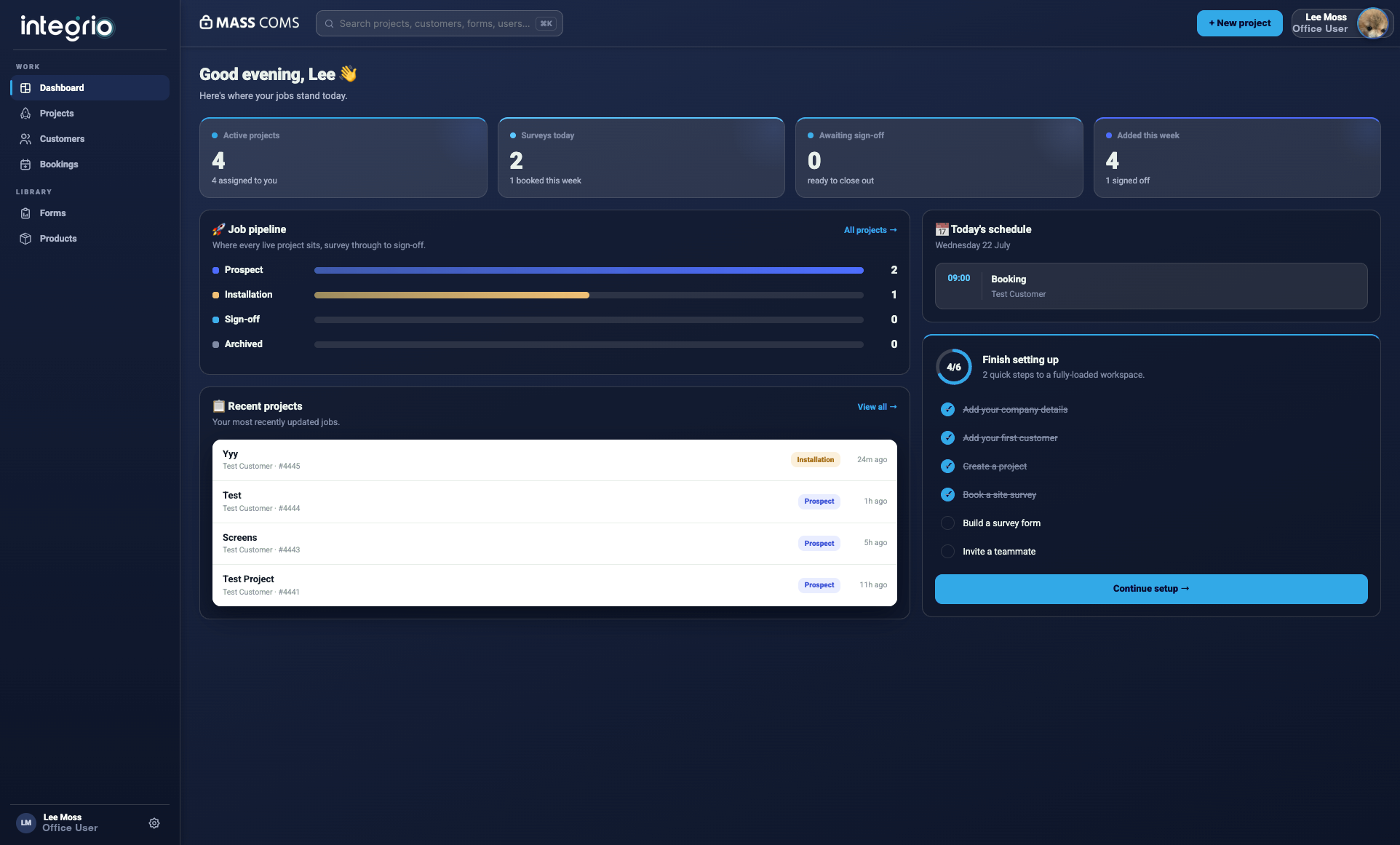
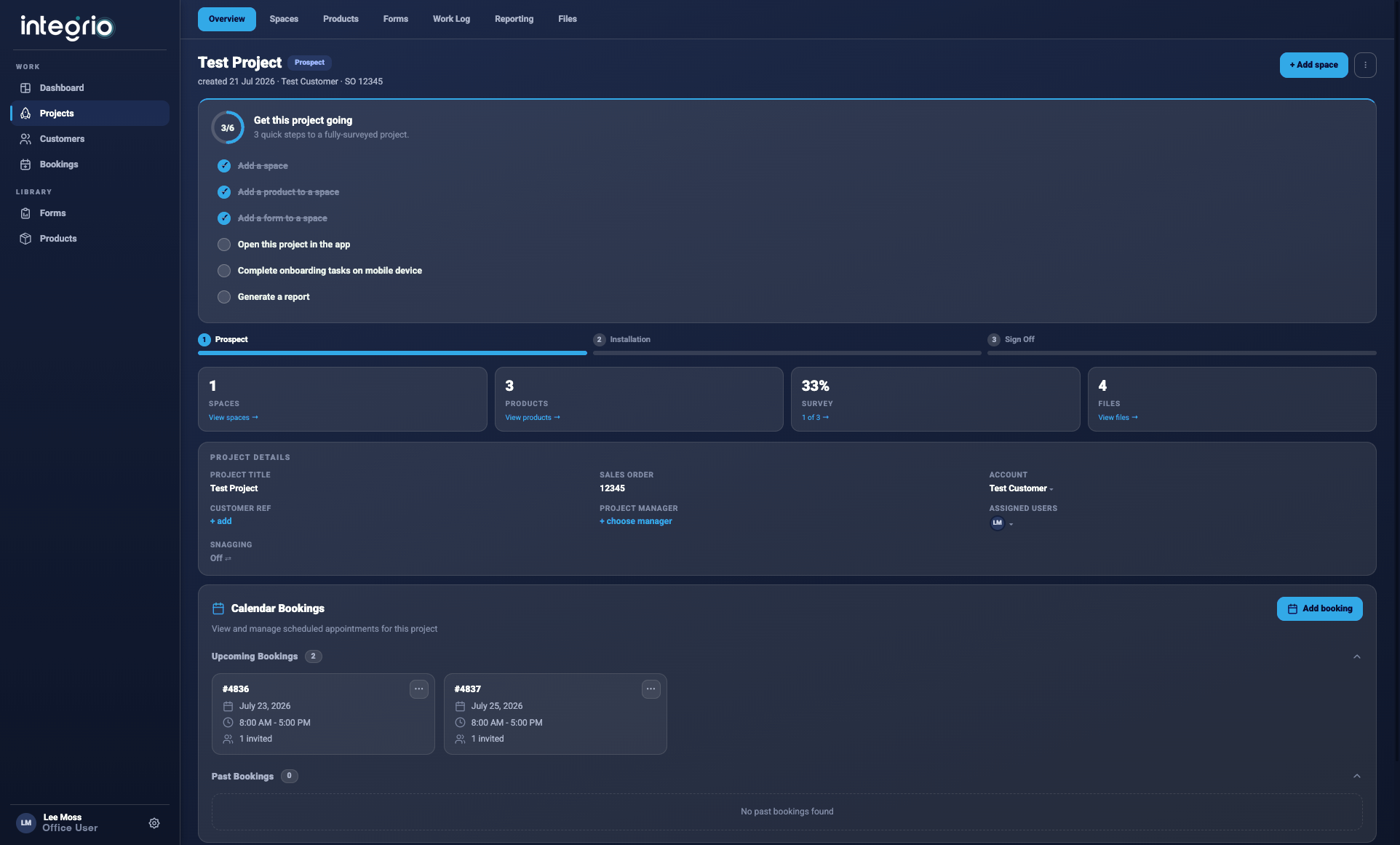
The Integrio project overview tracking a commercial rooftop solar and battery installation
Renewables recordLive
412Panels
6Inverters
8Chargers
Depot roof · Inverter 2 commissionedUpdated

Serial captured, string test form complete, G99 commissioning task closed. Ready for the handover pack.

What software do commercial solar, battery and EV charger installers use to track installations?

Integrio tracks each panel, inverter, battery and charger from delivery to handover: delivery schedules checked in by QR, serials and data points per product, string and commissioning forms, DNO and G99 steps as workflow tasks, crews on a calendar, and O&M tickets afterwards. It does not design PV systems, submit G99 applications, issue MCS certificates or manage chargers.

Last updated . Facts checked on 30 September 2026 against MCS: The 2026 Low Carbon Landscape (H1 2026 installation figures), MCS: MIS 3002 Issue 6.0, The Solar PV Installation Standard (18/03/2026), National Grid Electricity Distribution: G99 connection procedures, Electricity North West: G98 micro-generation and storage connections, IET: Code of Practice for Grid-connected Solar Photovoltaic Systems, 2nd Edition and IET: Code of Practice for Electric Vehicle Charging Equipment Installation, 5th Edition.

Renewables & EV charging, at a glance

Market
MCS recorded 148,531 certified solar installations and 36,000 battery installations in January–June 2026; heat pumps were just over 25,000, down 17% on the same period of 2025.
Grid connection
G99 applies to installations rated above 16 A (3.68 kW) per phase, or that don't meet G98 (National Grid Electricity Distribution).
Solar PV handover
MIS 3002 Issue 6.0: the document pack includes copies of all commissioning forms and checklists, maintenance requirements, manuals and warranty details; MCS registration follows within 10 working days of commissioning.
Codes of practice
The IET Code of Practice for Grid-connected Solar PV (2nd ed., 2022) covers commissioning, monitoring and maintenance; the IET EV charging code (5th ed., 2023) covers domestic, on-street, commercial and industrial sites.
What Integrio does not do
PV design or yield modelling, G98/G99 submissions, MCS certification, or charge point back office (CPMS/OCPP).
Price
Field Service User from £15 per month, Office User from £65 per month. Free 7-day trial, no credit card required.
01Solar PV
02Battery storage
03EV charge points
04O&M contracts

The challenge

Hundreds of serials. One grid connection. A handover pack at the end.

A commercial solar, battery or charger job is a lot of serialised product arriving on pallets, a DNO process that has to run alongside the install, and test records that have to line up with the kit that was actually fitted. When that lives in spreadsheets, supplier emails and paper test sheets, the handover pack is where it all comes apart.

01

Deliveries that don't match the order

Panels, inverters, optimisers, batteries and chargers arrive in part-loads from different suppliers. Without a delivery schedule per project, short deliveries are found on the roof, not at the gate.

02

Serials lost between site and office

Inverter and battery serials get written on the back of a test sheet or photographed on someone's phone. MIS 3002's model PV array test report asks for the inverter make, model and serial number.

03

Test sheets that don't tie to the kit

String tests record Voc, Isc, polarity and insulation resistance per string. If the sheet isn't attached to the string and inverter it describes, nobody can find it when a fault is reported.

04

The DNO process runs on memory

Above 16 A per phase, G99 means application, connection offer, acceptance, installation, then commissioning and witness testing before installation documentation. Those steps get missed when they live in someone's inbox.

05

Crews and pallets on different plans

Roofers, electricians and commissioning engineers need to arrive after the kit and the access equipment, not before. A calendar that can't see the delivery schedule books wasted days.

06

Handover and O&M start from scratch

The handover pack needs every commissioning form, manuals and warranties. When a fault comes in two years later, the O&M team needs the same record: which serial, which string, which test.

One continuous record

Deliver. Install & test. Connect. Hand over & maintain.

One record per project and per product, so what was ordered, delivered, fitted, tested and handed over is the same list — and it's still there when the O&M ticket arrives.

01

Deliver

Build a delivery schedule for each project. Track incoming panels, inverters, batteries and chargers from supplier to site, flag incomplete orders and check items in by scanning their QR codes.

02

Install & test

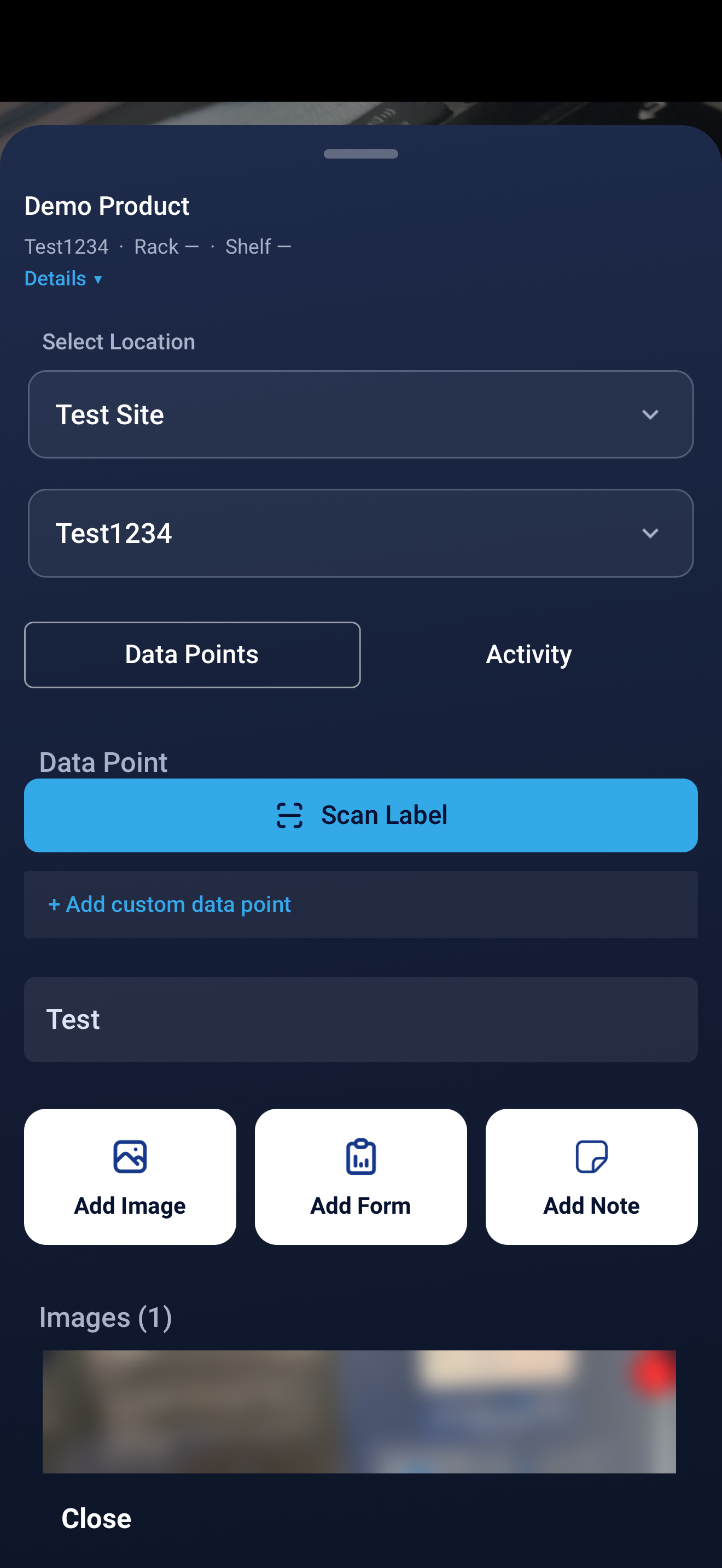
Crews record serials and other data points against each product as it's fitted, and complete string test and commissioning forms attached to that product, with mandatory fields that must be filled before sign-off.

03

Connect

Run the DNO connection as workflow tasks — application, offer, acceptance, commissioning and witness testing, installation documentation — with trigger tasks and instructions so the next step starts when the last one closes.

04

Hand over & maintain

Pull the commissioning forms, product list, photos and sign-off into a branded handover pack. Afterwards, O&M tickets, maintenance visits and warranty dates sit against the same installed products.

One connected record

The kit list, the test sheets and the crew calendar in one place.

Office teams build the project, the delivery schedule and the connection workflow in the portal. Installers and commissioning engineers work from the iOS and Android apps, offline if the roof has no signal, and every serial and test result lands on the product it belongs to.

Search every installed product by customer, site or space, with its full history

Testing and commissioning forms with mandatory fields before project sign-off

Warranty periods tracked, with alerts when they approach expiry

Renewables workspace in Integrio
Renewables mobile field workflow

Renewables toolkit

Key tools for solar, battery and EV charger installers.

Deliveries

Delivery schedules

Manage deliveries from supplier to site in real time. See what's on order, partial or delivered per project, flag incomplete orders and check pallets in with QR codes.

Products

Per-product data points

Define the fields each product type needs — serial number, rating, firmware, configuration — and capture them on site against that panel, inverter, battery or charger.

Testing

String & commissioning forms

Attach as many forms as you need to a product: string tests, commissioning checklists, sign-off forms. Mandatory fields stop a job being signed off with a gap in the record.

Workflows

DNO & G99 steps as tasks

Model your connection process on a Kanban workflow. Trigger tasks start the next stage automatically, and task instructions carry the checklist for each step.

Crews

Crews on the calendar

Schedule installers, electricians and subcontractors on a shared calendar with a live map and travel time, and give contractors and third parties access to Integrio.

Aftercare

O&M tickets & warranties

Log faults as helpdesk tickets against the installed product, schedule maintenance visits from the ticket, set SLAs per customer and track warranty periods.

Every update has a place

Every installed product has a place on site.

Installed products are held by customer, site and space, so the inverter in plant room 2 or the charger in bay 14 can be found with its serials, test forms and helpdesk history attached.

Explore AR & floor plans ↗

Renewables FAQ

Frequently asked questions.

01What does Integrio do for a commercial solar, battery or EV charger installer?+

It tracks the products you install and the work around them: delivery schedules for panels, inverters, batteries and chargers; serial numbers and other data points per product; string test and commissioning forms; DNO connection steps as workflow tasks; crews on a calendar; snagging, sign-off and the handover pack; then O&M tickets, maintenance visits and warranty tracking.

02Does Integrio design PV systems or model yield?+

No. Integrio does not do PV layout, string design or yield and performance modelling. Keep using your design tool, and record the as-installed products, serials and test results in Integrio.

03Does Integrio submit G98 or G99 applications to the DNO?+

No. Integrio does not submit connection applications or notifications. You can set up the stages of your DNO process — for G99, National Grid lists application, connection offer, acceptance, installation, commissioning and witness testing, then installation documentation — as workflow tasks, attach the forms and track who owes what.

04Does Integrio issue MCS certificates?+

No. Integrio is not an MCS certification body and does not register installations on the MCS Installation Database. MIS 3002 Issue 6.0 says the MCS contractor registers the installation and generates the MCS certificate no later than 10 working days after commissioning. Integrio helps you assemble the handover documentation the standard lists, such as copies of commissioning forms and checklists, manuals and warranty details.

05Is Integrio a charge point management system?+

No. Integrio is not a charge point back office or CPMS and does not talk OCPP to chargers. It tracks the installation: which charger model and serial went where, its commissioning form, the crew that fitted it and the tickets raised against it afterwards.

06Can we record string test results against each string and inverter?+

Yes. Build a string test form with the fields you use — for example the Voc, Isc, polarity and insulation resistance fields in MIS 3002's model PV array test report — attach it to the product, and make fields mandatory so they must be completed before project sign-off.

07Does it work for heat pump installs too?+

Heat pumps are serialised products with commissioning forms and aftercare, so the same product, form and helpdesk tools apply. Our focus is commercial solar PV, battery storage and EV charging.

See it in your environment

Start your free 7-day trial.